This guide contains Amazon links. As an Amazon Associate, Backyard Pool Tips earns from qualifying purchases — see our affiliate disclosure. Recommendations are based on suitability and running cost, not commission.
Robots vs suction-side vs pressure-side vs manual
- Robotic cleaners
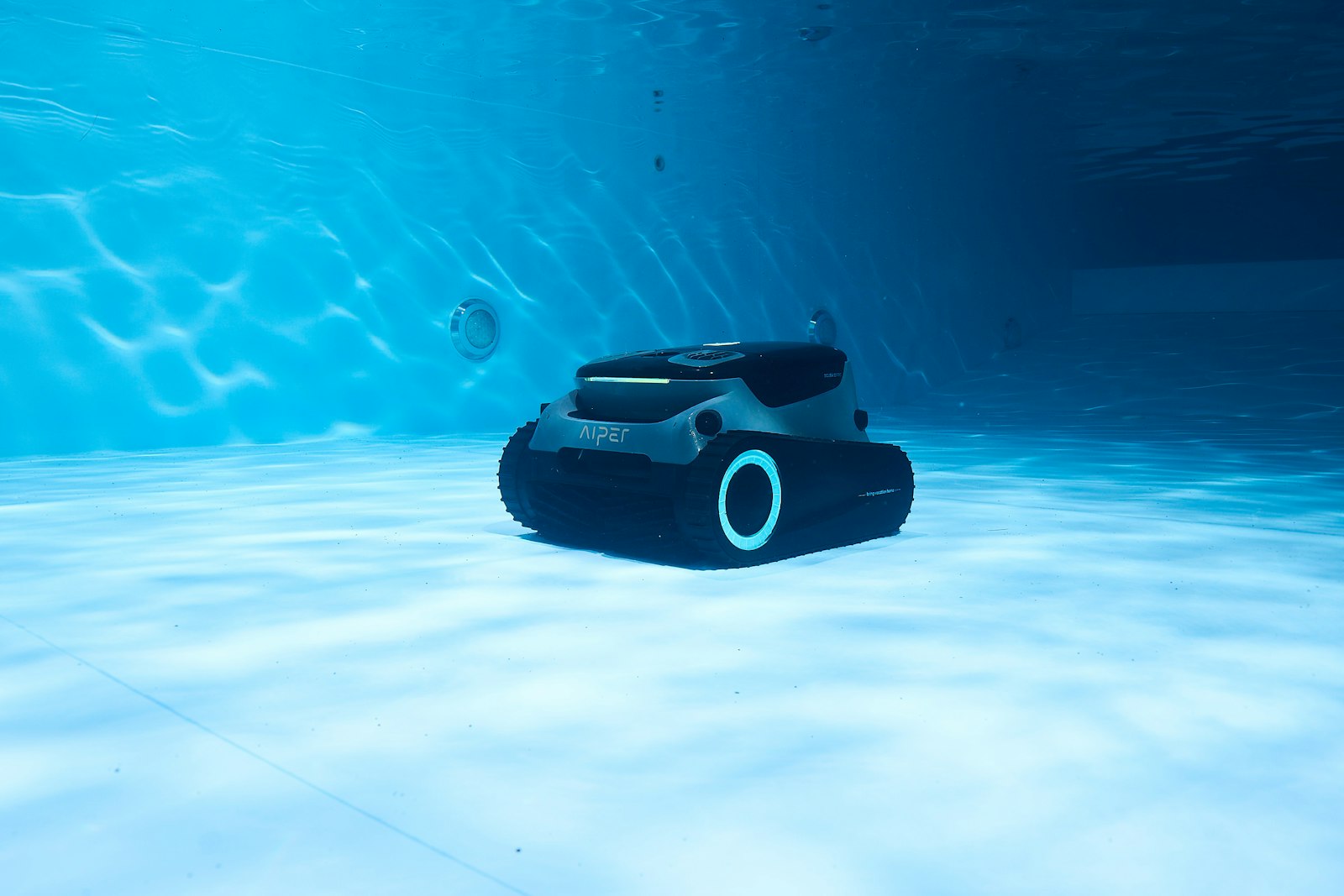
- Fully self-contained units with their own motor and filter, running independently of your pump and filter system. Highest upfront cost, but the most thorough and hands-off option.
- Suction-side cleaners
- Connect to your pool's skimmer or a dedicated suction line, using your existing pump's suction to move around and pick up debris. Cheaper, but adds load to your pump and filter.
- Pressure-side cleaners
- Connect to a return line and use water pressure to move and collect debris in their own bag, often with a booster pump. Good for larger debris like leaves, less thorough on fine silt.
- Manual vacuums
- Pole-mounted, connected to the skimmer or a dedicated vacuum port, operated by hand. Lowest cost, but the most time and effort.
Robots have become the default recommendation for most owners because they clean more thoroughly (floor, walls, and often the waterline) without adding wear to your existing pump — worth the higher upfront cost for most pools used regularly.
What separates a good climber from a bad one
Wall-climbing ability is the single biggest performance difference between robots at similar price points, and it's driven by two things: suction strength and how the robot distributes its own weight while climbing. A robot that's genuinely built for wall climbing keeps steady contact and traction as it transitions from floor to wall; a weaker one loses suction partway up, drops back down, and ends up re-covering the same floor area repeatedly instead of finishing the walls and waterline. Reading actual owner reviews for "climbs walls" or "gets stuck" complaints tells you more than the marketing copy will.
Cordless vs corded — the real trade-off
Cordless robots run on battery and are far more convenient day to day — no cable to tangle, drag debris back into the pool, or fish out of the water after each use. The trade-off is a fixed runtime per charge, typically 60–150 minutes depending on the model, which caps how much pool a single cycle can cover. Corded units aren't limited by battery, but the cable itself needs managing — a poorly designed cable can tangle on steps and ladders or drag debris back through cleaned areas. For most residential pools, cordless convenience outweighs the runtime limitation, especially as battery life has improved significantly on newer models.
Runtime and coverage vs your pool size
Match the robot's rated coverage area and runtime to your actual pool size with some margin, not the exact number — a robot rated for exactly your pool's square footage often needs a full cycle to just barely finish, leaving no buffer for a heavier debris day. As a rough guide, look for at least 20–30% more rated coverage than your pool's actual surface area if you want a genuinely complete clean in a single cycle rather than needing two runs.
Filter maintenance realities
Every robot's filter basket needs regular emptying — after every cycle for pools with heavy leaf litter or high bather load, every few cycles for a well-covered, lightly used pool. A full filter is the most common reason a robot's cleaning performance seems to drop off partway through a cycle: it's not losing power, it's just full and no longer picking anything else up. Rinsing the filter properly (not just emptying it) after each use also matters — a filter clogged with fine debris restricts flow even when it looks empty.
How long should a robotic cleaner last?
A well-maintained robot typically lasts 3–5 years before the motor or battery degrades to the point of needing replacement, though battery capacity on cordless models tends to decline gradually well before that — expect noticeably shorter runtime by year two or three even with good care. Rinsing the unit and its filter after every use, storing it out of direct sun when not in use, and avoiding running it in water with wildly unbalanced chemistry (which can degrade seals and components faster than normal) are the main things that affect how long a robot actually lasts versus its rated lifespan on paper.
Is a robot worth it over manual vacuuming?
For most owners, yes — the time saved is the real value, not just the cleaning quality. A manual vacuum session commonly takes 30–60 minutes of hands-on time; a robot does the same job (often more thoroughly, including walls) while you do something else entirely. Priced out over a typical 3–4 month swim season, even a mid-range robot commonly costs less than what a professional cleaning service would charge for the same frequency of cleaning — the upfront cost is the main barrier, not the ongoing value.
Five cleaners worth considering
Spanning above-ground budget options through to premium units built for larger inground pools.
Aiper Seagull SE
Cordless robotic cleaner · Aiper
Strengths
- Strong suction and genuine wall-climbing ability
- Cordless — no cable to manage or tangle
Trade-offs
- Battery runtime caps a single cycle on larger pools
Best for: most above-ground and smaller inground pools where cordless convenience and reliable wall climbing matter most.
Check current price on Amazon →Beatbot Sora 70
Robotic cleaner · Beatbot
Strengths
- 360-degree cleaning coverage including waterline
- Strong performance on larger pools
Trade-offs
- Highest upfront cost of this list
- More capability than a smaller pool typically needs
Best for: larger pools where full-coverage cleaning (floor, walls, waterline) in fewer cycles justifies the premium price.
Check current price on Amazon →Aiper Scuba S1
Cordless robotic cleaner · Aiper
Strengths
- Extended battery runtime versus entry-level cordless models
- Smart navigation reduces repeated coverage of the same area
Trade-offs
- Costs more than the Seagull SE for the runtime upgrade
Best for: larger above-ground or mid-sized inground pools where a standard cordless runtime falls just short of a full clean.
Check current price on Amazon →WYBOT C1
Cordless robotic cleaner · WYBOT
Strengths
- App-based scheduling and control
- Solid all-round cleaning for standard inground pools
Trade-offs
- App dependency adds a step versus a simple one-button start
Best for: owners who want scheduled, hands-off cleaning managed from a phone rather than starting each cycle manually.
Check current price on Amazon →WYBOT A1
Cordless robotic cleaner · WYBOT
Strengths
- Lowest cost of this list while still being a genuine robotic cleaner
- Straightforward one-button operation
Trade-offs
- Wall-climbing performance is more limited than premium options
Best for: smaller above-ground pools on a budget, where floor-focused cleaning is the main requirement.
Check current price on Amazon →Our verdict by scenario
- Most pools
- The Aiper Seagull SE balances price, cordless convenience, and real wall-climbing ability.
- Larger pool, budget flexible
- The Beatbot Sora 70 gives full 360-degree coverage in fewer cycles.
- Standard runtime falls short
- The Aiper Scuba S1's extended battery closes the gap.
- Want app-scheduled cleaning
- The WYBOT C1 hands off the day-to-day scheduling.
- Tightest budget
- The WYBOT A1 is a genuine robotic cleaner for the least money.
Whatever you choose, empty and rinse the filter after every cycle in the first few weeks until you've got a feel for how quickly it fills for your specific pool.
Common questions
Do robotic cleaners actually climb walls, or just the floor?
The better ones genuinely climb walls and the waterline, not just the floor — but it varies a lot by model. Wall-climbing ability depends on suction strength and traction, so it's worth checking specifically rather than assuming every robot marketed as one does it well.
Cordless or corded — which is actually better?
Cordless is far more convenient day to day (no cable to tangle or fish out), but runs on battery life that limits a single cleaning cycle. Corded units run as long as needed but the cable itself can tangle or drag debris back into the pool if not managed. For most owners, cordless convenience outweighs the runtime trade-off.
How often does the filter basket need emptying?
After every cleaning cycle for pools with heavy debris (leaves, high bather load), or every few cycles for a well-covered, lightly-used pool. A full filter basket is the most common reason a robot's cleaning performance seems to drop off mid-cycle.
Can a robot replace my pump and filter system entirely?
No — a robot cleans debris and film off surfaces, but your pump and filter system is still what circulates and chemically treats the water. The two do different jobs and both are needed for a genuinely clean, balanced pool.