This guide contains Amazon links. As an Amazon Associate, Backyard Pool Tips earns from qualifying purchases — see our affiliate disclosure. Recommendations are based on suitability and running cost, not commission.
First, what's actually being compared
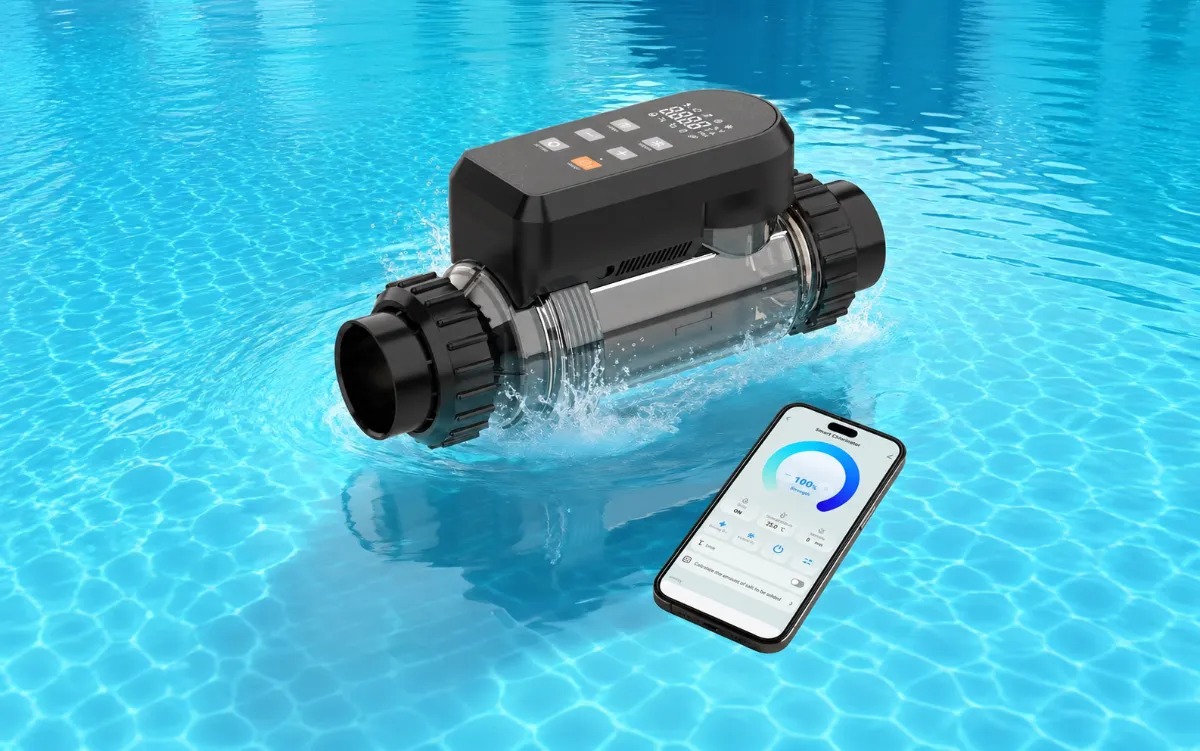
"Salt vs chlorine" is a slightly misleading way to frame this, and it trips people up at the shop counter more than almost anything else we get asked about. A salt system doesn't replace chlorine — it makes chlorine, continuously, by running pool water containing dissolved salt through a cell that uses electrolysis to generate chlorine on-site. The alternative is buying and manually dosing chlorine yourself, as liquid, tablets, or granules. Both approaches sanitise the water with chlorine; the real comparison is how you get that chlorine into the pool, and what each approach costs to run.
Upfront cost
A salt chlorination system — chlorinator control unit plus the salt cell — typically costs $400–1,000 installed, on top of the salt itself to bring a pool up to the right concentration (usually a one-time cost of $50–100 for an average residential pool, since salt doesn't get consumed, only diluted by splash-out and backwashing). Manual chlorine dosing has no comparable upfront hardware cost if you're already set up with basic test kits and dosing equipment — you're simply buying chlorine as you go.
The 3-year running cost, worked through
This is where the comparison actually matters. Using rough figures for an average residential pool (~20,000 gallons):
- Manual chlorine
- Roughly $350–550 a year in chlorine product alone, more in hot climates or with heavy pool use — no equipment cost, but no equipment to amortise either. Over 3 years: roughly $1,050–1,650.
- Salt system
- $400–1,000 upfront, plus roughly $30–70 a year in electricity to run the cell and occasional salt top-ups (typically under $20 a year). Over 3 years: roughly $550–1,210 including the hardware.
The gap narrows or reverses if a salt cell needs replacing within that 3-year window — cells typically cost $200–400 and last 3–5 years — but even factoring in a mid-cycle replacement, salt systems commonly come out roughly even or ahead over three years, and clearly ahead from year four onward once the hardware cost is fully absorbed.
Weekly effort
Manual dosing means buying, storing, and adding chlorine on a regular schedule — typically weekly, more often in hot weather or after heavy pool use — plus keeping an eye on levels between doses since they drift down steadily as chlorine gets used up. A salt system produces chlorine continuously while the pump runs, so day-to-day effort drops mostly to periodic testing and occasional adjustment rather than a recurring dosing chore. This is the part owners tend to value most, even more than the raw cost difference.
Climate and pool-type fit
Salt systems work well in most climates and most standard pool types, but there are real exceptions worth checking before converting:
- Some natural stone coping, unsealed concrete, and certain metal fixtures (ladders, lights, heaters) can be affected by salt exposure over time if they're not rated for it.
- Vinyl liner pools are generally fine with salt, but check your liner manufacturer's guidance — quality varies.
- Very cold climates where the pool sits closed for a large part of the year get proportionally less benefit from a salt system's main advantage (continuous low-effort chlorine production), since it's mostly sitting idle anyway.
For most standard fibreglass, plaster, and vinyl inground pools with salt-rated equipment, none of this is a practical concern — it's mainly worth checking for older pools with original fixtures, or unusual finishes.
Getting the most life out of a salt cell
If your cell has stopped producing chlorine altogether, see our dedicated troubleshooting guide for the six most common causes and how to work through them in order.
Cell lifespan is the biggest wildcard in the running-cost math above, and it's largely within your control. Keeping pH, alkalinity, and salt level within the manufacturer's specified ranges is what actually determines whether a cell lasts closer to three years or closer to five — scale buildup from high pH or calcium hardness is the most common thing that shortens cell life, since it coats the cell's plates and makes it work harder to produce the same output. Most cells also benefit from an occasional inspection and light cleaning (a brief acid wash if scale is visible), which most manufacturers cover clearly in the unit's manual. Skipping this is the single most common way people end up replacing a cell earlier than they needed to.
Five salt chlorination systems worth considering
Spanning above-ground-friendly budget options through to systems built for larger pools.
Hayward AquaRite Salt Chlorination System
Salt chlorinator · Hayward
Strengths
- The most widely installed system, easy to get serviced
- Reliable cell life with proper water balance
- Straightforward digital control panel
Trade-offs
- Mid-to-high upfront cost
- Replacement cells aren't the cheapest on the market
Best for: most standard inground pools where proven reliability and easy servicing matter most.
Check current price on Amazon →Pentair IntelliChlor IC40
Salt chlorinator · Pentair
Strengths
- Strong integration with Pentair automation systems
- Solid chlorine output for mid-to-large pools
Trade-offs
- Best value if you're already in the Pentair ecosystem
Best for: inground pools already running Pentair pumps or automation, for the smoothest integration.
Check current price on Amazon →Intex Krystal Clear Salt Water System
Salt chlorinator · Intex
Strengths
- Lowest upfront cost of this list
- Built for above-ground pool compatibility
Trade-offs
- Lower chlorine output — sized for smaller above-ground pools only
Best for: above-ground pools where a full inground-grade system would be overkill and overpriced.
Check current price on Amazon →Jandy TruClear XL Salt Chlorination System
Salt chlorinator · Jandy
Strengths
- Rated for pools up to 45,000 gallons
- Strong output headroom for heavy bather load
Trade-offs
- Highest upfront cost of this list
- More capacity than a standard residential pool needs
Best for: larger pools, or ones with consistently heavy use, where a standard-sized cell would be undersized.
Check current price on Amazon →XtremepowerUS Salt Chlorine Generator
Salt chlorinator · XtremepowerUS
Strengths
- Good output-to-price ratio for larger pools
- Straightforward installation
Trade-offs
- Less established service network than legacy pool-specific brands
Best for: larger pools on a budget, where the Jandy above is more capacity — and cost — than needed.
Check current price on Amazon →Our verdict by scenario
- Most inground pools
- The Hayward AquaRite is the safe, well-supported choice.
- Already running Pentair gear
- The Pentair IntelliChlor IC40 integrates most smoothly.
- Above-ground pool
- The Intex Krystal Clear system is sized and priced appropriately.
- Larger pool, budget flexible
- The Jandy TruClear XL has the output headroom.
- Larger pool, tighter budget
- The XtremepowerUS generator gets you there for less.
Whichever you choose, keep pH and salt level within the manufacturer's specified range — it's the single biggest factor in how long the cell actually lasts.
Common questions
Is salt water gentler on skin and eyes than chlorine?
Many people find it feels gentler, since salt levels are far lower than ocean water and the water lacks the harsh chemical smell of over-chlorinated water. It's still chlorinated water chemically — just produced on-site at a steadier, lower level rather than dosed in batches.
Can a salt system corrode pool equipment or fixtures?
It can, over time, affect certain metal fixtures, some natural stone, and unsealed concrete if salt levels run high or equipment isn't rated for saltwater exposure. Check that ladders, lights, and heaters are salt-system compatible before converting, and keep salt levels within the manufacturer's specified range.
How often does a salt cell actually need replacing?
Typically every 3–5 years with normal use, though it varies by brand, water balance, and how many hours a day the cell runs. Keeping pH and salt level in range extends cell life; letting either drift shortens it.
Can I convert an existing chlorine pool to salt without draining it?
Yes — conversion is normally just installing the chlorinator and cell in the existing plumbing and adding salt to the existing water, no draining required. It's a comparatively simple upgrade for most standard inground and above-ground pools.