This guide contains Amazon links. As an Amazon Associate, Backyard Pool Tips earns from qualifying purchases — see our affiliate disclosure. Recommendations are based on suitability and running cost, not commission.
What each cover type actually does
"Pool cover" covers a lot of genuinely different products, and picking the wrong category is the most common mistake we see — usually someone buying a solar cover expecting it to double as a safety cover, which it was never built to do.
- Solar covers
- Lightweight bubble-style covers that float on the surface, trap solar heat, and dramatically cut evaporation. Cheapest option, but not load-bearing and not built to survive winter in a freeze-prone climate.
- Thermal covers
- Similar heat-retention purpose to solar covers but usually heavier, more durable material — often chosen for pools used year-round in mild climates where a bubble cover would wear out too fast.
- Safety covers
- Mesh or solid covers rated and anchored to support real weight — the only category that should ever be relied on for child or pet safety. Cost more and are typically fitted for inground pools specifically.
- Winter covers
- Built to keep debris and sunlight out during the off-season, secured with cables, water bags, or anchors. Not necessarily load-bearing unless separately rated as a safety cover too.
Matching cover type to what actually matters to you
Most buying decisions come down to one priority overriding the others:
- Hot climate, want to extend the swim season — a solar or thermal cover pays for itself fastest here.
- Cold climate, closing up for the off-season — a proper winter cover is the right tool, not a repurposed solar cover.
- Young kids or pets around the pool — a rated safety cover isn't optional, regardless of what else you also use day to day.
- Water-scarce area, high evaporation losses — a solar cover's evaporation reduction is usually the single biggest lever available.
These aren't mutually exclusive — plenty of owners run a safety cover for security and a solar cover for daily heat retention, swapping between them.
What a cover actually saves
Evaporation is the single biggest source of both water loss and heat loss from an uncovered pool — more than conduction through the pool walls or overnight radiative cooling combined, in most climates. A well-fitted cover can cut evaporation by up to 95% while it's on. For a heated pool, that translates to real money: uncovered heated pools commonly cost an extra $50–100 a month in heating during swim season compared to a consistently covered one, on top of the water refill cost from evaporation itself. For an unheated pool, the savings show up mainly as less frequent topping-up and a few degrees of natural solar warming from a solar cover.
Manual vs roller systems
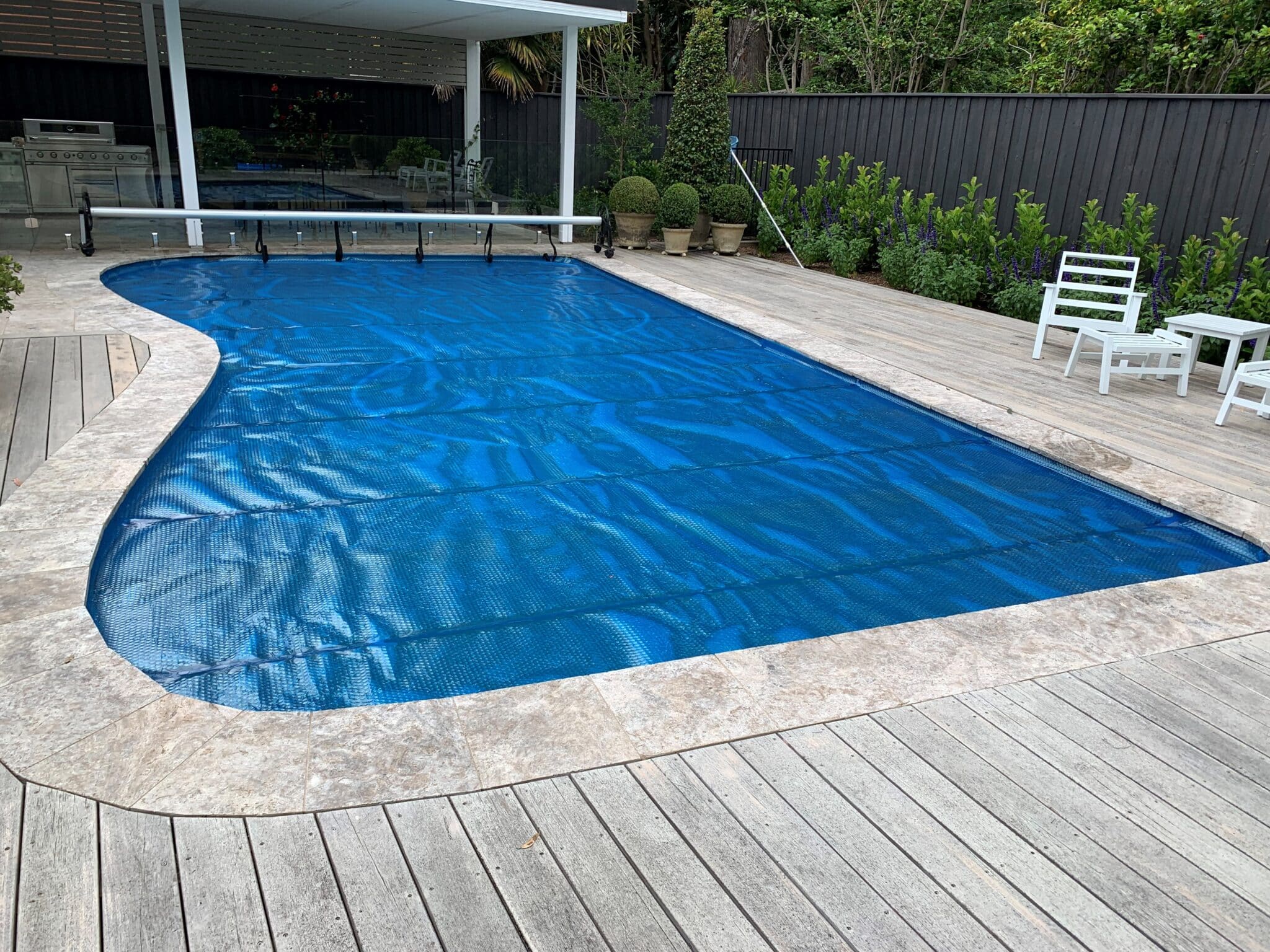
A manual cover is simply laid over the pool by hand and secured — the cheapest option, and genuinely fine for smaller pools or covers that go on and off infrequently. A roller system mounts the cover on a reel, letting you unroll and retract it in under a minute. Rollers cost more upfront but make daily use of a solar cover far more likely to actually happen — a cover that's a hassle to put on tends to get left off, which defeats the purpose. For anyone using a solar cover daily on a larger pool, a roller is worth the extra cost.
Getting the size right
Measure at the water's edge, not the surrounding deck or coping — this is the single most common sizing mistake. Check whether a listed size is the cover's finished size or an oversized blank meant to be trimmed to fit; many solar and winter covers are sold slightly larger than standard pool sizes specifically so they can be cut down, which is more forgiving than ordering undersized. Irregular inground shapes (kidney, freeform) typically need a custom-cut cover rather than an off-the-shelf round or rectangular one.
Five covers worth considering
Spanning solar heat-retention covers through to heavy-duty winter covers, in both budget and durable options.
Sun2Solar Blue Solar Pool Cover
Solar cover · Sun2Solar
Strengths
- Strong heat retention and evaporation reduction
- Available in multiple standard round and rectangular sizes
Trade-offs
- Not load-bearing — no substitute for a safety cover
- Bubble material wears faster than heavier thermal covers
Best for: extending the swim season and cutting evaporation in a warm-to-hot climate.
Check current price on Amazon →Robelle 24ft Heavy Duty Super Winter Pool Cover
Winter cover · Robelle
Strengths
- Heavy-duty material built for a full off-season
- Blocks sunlight well, helping limit algae growth over winter
Trade-offs
- Not rated as a safety cover — still needs separate anchoring/care around children and pets
Best for: a straightforward, durable winter cover for closing up a round above-ground or standard inground pool.
Check current price on Amazon →GuardKove Round Pool Cover with 4-Way Windproof System
Winter cover · GuardKove
Strengths
- Windproof anchoring system holds up well in exposed, gusty yards
- Solid debris and sunlight blocking
Trade-offs
- More setup involved than a simple water-bag-secured cover
Best for: yards that get real wind, where a standard winter cover keeps working loose.
Check current price on Amazon →VEVOR Solar Pool Cover
Solar cover · VEVOR
Strengths
- Lower cost than premium solar cover brands
- Reasonable heat retention for the price
Trade-offs
- Shorter expected lifespan than heavier-duty options
Best for: trying a solar cover without committing to premium pricing, especially on a smaller pool.
Check current price on Amazon →POOLHACKER 550D Heavy-Duty Winter Pool Cover
Winter cover · POOLHACKER
Strengths
- 550-denier fabric holds up well across multiple seasons
- Strong debris and UV blocking
Trade-offs
- Bulkier to store during the swim season than a lighter cover
Best for: owners who want a winter cover that lasts several seasons rather than replacing a lighter one each year.
Check current price on Amazon →Our verdict by scenario
- Extend the swim season
- The Sun2Solar cover gives the strongest heat retention of this list.
- Standard winter close-up
- The Robelle winter cover is a durable, straightforward choice.
- Exposed, windy yard
- The GuardKove's windproof anchoring stays put where others work loose.
- Trying solar for the first time
- The VEVOR is the lowest-commitment way to test the benefit.
- Want a winter cover that lasts years
- The POOLHACKER 550D is built for the long haul.
Whatever you choose for daily or seasonal use, a dedicated safety cover is a separate purchase if young kids or pets are around the pool — don't rely on any of the above for that job.
Common questions
Do I need a different cover for summer and winter?
Many owners use one cover type year-round, but a solar cover left on through winter in a freezing climate can be damaged by ice, and a heavy winter cover left on through summer blocks sun and does a job the pool doesn't need done. Matching cover to season gets the most life out of each.
Will a solar cover actually heat my pool, or just reduce evaporation?
Both. The bubble structure traps solar heat and transfers some of it into the water, typically raising temperature a few degrees over several sunny days, while also cutting evaporation — which is usually the bigger effect on both water loss and heat retention.
Can any cover double as a safety cover?
No — only covers specifically rated and anchored as safety covers should be relied on to support weight. A solar or standard winter cover can look solid but will not reliably hold a child or pet, and treating one as if it will is a genuine safety risk.
How do I know what size cover to order?
Measure the water's edge, not the deck or coping, and check whether the listed size is the cover's finished size or the size before trimming — many solar and winter covers are sold slightly oversized so they can be trimmed to an exact fit.