This guide contains Amazon links. As an Amazon Associate, Backyard Pool Tips earns from qualifying purchases — see our affiliate disclosure. Recommendations are based on suitability and running cost, not commission.
Flow rate matters more than horsepower
It's tempting to shop by horsepower, because it's the number printed biggest on the box. But horsepower just tells you how hard the motor works — it doesn't tell you whether the pump is actually right for your pool. What matters is flow rate (gallons per hour, GPH) matched to your pool's volume, because that determines how long it takes to turn over — filter — your entire pool's water.
A pump that's too small for the pool runs constantly and still can't keep up. A pump that's oversized wastes electricity and can stress smaller above-ground plumbing and fittings that weren't built for higher pressure. The right pump is the smallest one that comfortably turns your pool over once every 8–12 hours.
Sizing to your pool
Turnover rate is the time it takes to filter a volume of water equal to your whole pool. As a rough guide for above-ground pools:
- Up to 15,000 gal
- A pump rated around 1,500–2,200 GPH is typically enough.
- 15,000–24,000 gal
- Look for 2,200–3,500 GPH.
- Over 24,000 gal
- You're into inground-pump territory, or need a higher-flow pump specifically rated for larger above-ground pools.
Check your pool's actual volume (most manufacturers publish this by pool diameter and wall height) rather than guessing — "medium" and "large" mean different things across brands.
Single-speed vs variable-speed for smaller pools
Variable-speed pumps are worth it on larger inground pools where the energy savings compound over a bigger, longer-running system (see our inground pump guide for that math). On a smaller above-ground pool, the case is weaker: the pump runs fewer hours at lower cost overall, so the payback period on the extra upfront cost of a variable-speed unit is a lot longer — sometimes longer than the pump itself will last. A well-sized single-speed pump with a simple timer is usually the more sensible choice here, unless you're running a genuinely large above-ground pool.
Noise — the thing nobody mentions in the spec sheet
Above-ground pumps typically sit in the open, close to a patio or a neighbour's fence line, not tucked away in equipment enclosures like inground setups. A pump that's a few decibels louder than another is a much bigger deal here than the spec sheet suggests. Where possible, check actual owner reviews for noise complaints rather than trusting a manufacturer's "quiet operation" claim alone.
What it actually costs to run
A typical above-ground pump draws somewhere between 0.5 and 1.5 kWh per hour of runtime depending on size. Running an 8-hour cycle daily at an average electricity rate, that's roughly a few dollars a week for a well-sized pump — noticeably more if you're running an oversized pump longer than it needs, which is one of the most common ways people overpay on a pool that isn't actually working any better for it.
Worked example: a 1 kWh pump running 8 hours a day at a typical residential rate of around $0.16 per kWh costs roughly $1.28 a day, or about $9 a week. Drop to 6 hours a day once the water is clear and stable (rather than running it longer "just in case") and that same pump costs closer to $6.75 a week — a meaningful saving over a full season for a five-minute timer adjustment.
Does the filter type matter for pump choice?
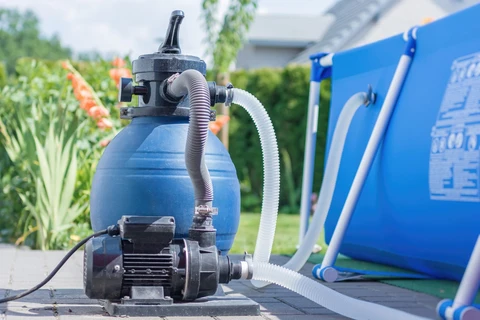
Most budget and mid-range above-ground pumps are sold as a matched set with a sand filter, which is the simplest option to own — no cartridges to buy, just an occasional backwash. Cartridge filter pumps trade a bit more ongoing cost (replacement cartridges) for slightly finer filtration and a smaller footprint. For an above-ground pool, either does the job well; the pump's flow rate matters far more to your results than which filter type it's paired with, so don't let filter type be the deciding factor over correct sizing.
How long should a pump last?
A well-maintained above-ground pump typically runs for 5–8 years before the motor wears out, though budget units at the lower end of that range are common if they're run longer hours than they're rated for. If a pump is more than a few years old and starting to show the symptoms in our pump and filter troubleshooting guide — especially noise or repeated short cycling — it's often more cost-effective to replace it than keep repairing it, particularly on budget-tier pumps where parts can cost a meaningful fraction of a new unit.
Five pumps worth considering
Mixed budget and mid-range picks, since most above-ground pools don't need — or benefit from — a premium pump.
Intex SX2100 Krystal Clear Sand Filter Pump
2,100 GPH · Intex
Strengths
- Low upfront cost
- Simple to set up and maintain
- Well suited to smaller above-ground pools
Trade-offs
- Limited flow for anything over ~15,000 gallons
- Fewer advanced features than dual-speed models
Best for: smaller above-ground pools on a tight budget, where a straightforward sand filter pump does everything that's actually needed.
Check current price on Amazon →AQUASTRONG Dual-Speed Pool Pump with Timer
Dual-speed · AQUASTRONG
Strengths
- Built-in timer for set-and-forget scheduling
- Low-speed setting cuts running cost on quiet days
- Good flow range for mid-sized pools
Trade-offs
- Not as energy-efficient as a true variable-speed unit
- Slightly more to learn than a basic single-speed pump
Best for: owners who want some of the running-cost benefit of variable speed without paying inground-pump prices for it.
Check current price on Amazon →Bestway 2200 GPH Sand Filter Pump
2,200 GPH · Bestway
Strengths
- Competitive flow rate for the price
- Straightforward sand filtration
Trade-offs
- Basic feature set — no built-in timer
- Best suited to Bestway-brand or compatible pool fittings
Best for: a second reliable budget option if the Intex above isn't compatible with your pool's existing fittings.
Check current price on Amazon →VINGLI 3/4 HP 3435 GPH Pool Pump
3,435 GPH · VINGLI
Strengths
- Enough flow for larger above-ground pools
- Faster turnover on hot, high-use days
Trade-offs
- Overkill — and more running cost — for smaller pools
- Check noise reviews before buying if it'll sit near a patio
Best for: above-ground pools at the upper end of the size range (20,000+ gallons) that need genuinely higher flow.
Check current price on Amazon →BluSwim 1.5 HP Self-Priming Pool Pump
Self-priming · BluSwim
Strengths
- Self-priming — easier to get running after a dry start
- Generally quieter operation than budget alternatives
Trade-offs
- Costs more than the budget picks above
- Sand or cartridge filter typically sold separately
Best for: a pool sitting close to a patio or a neighbour's fence, where noise is the deciding factor.
Check current price on Amazon →Our verdict by scenario
- Tightest budget, smaller pool
- The Intex SX2100 does the job without paying for features you won't use.
- Want lower running costs
- The AQUASTRONG dual-speed pump is the best middle ground without inground-pump pricing.
- Larger above-ground pool
- Step up to the VINGLI for the flow rate to actually keep up.
- Near a patio or bedroom
- Pay the difference for the BluSwim and avoid the daily hum.
Whatever you land on, match it to your pool's actual volume first — that one number rules out more bad choices than any brand comparison will.
Common questions
Can I use an inground pool pump on an above-ground pool?
Technically often yes, but it's rarely a good idea. Inground pumps are usually sized for larger systems and higher flow than above-ground plumbing and fittings are built to handle, and they're not designed to be self-priming from a hose connection the way above-ground pumps are. Stick with a pump actually rated for above-ground use.
How many hours a day should the pump run?
Enough to turn the pool over once — roughly 8–12 hours a day for most above-ground pools, though a well-sized pump can often do it in less. Hot weather, heavy use, or a pool that's currently cloudy all call for running it on the longer end of that range.
Do I need a bigger pump if I add a heater or a water feature?
Not necessarily for a heater, since most above-ground heaters are designed to work within normal flow rates. A water feature that adds real head pressure (height the pump has to push water up) can be a different story — check the feature's own flow and pressure requirements before assuming your existing pump can handle it.
Sand filter or cartridge filter — which is actually easier to maintain?
Sand filters win on ongoing simplicity (backwash and forget), while cartridge filters win on not needing a backwash-water top-up and slightly finer filtration. Neither is objectively "easier" — it comes down to whether you'd rather buy replacement cartridges occasionally or top up water after backwashing.